
For light blue shirts, navy and burgundy ties give you the safest, sharpest professional contrast. Dark blue shirts need the opposite logic: lighter shades, warmer tones like gold or bronze, or texture, so the shirt and tie don't collapse into one flat block of colour. Beyond colour, get the fabric weight and pattern scale right, and the outfit looks deliberate rather than accidental.
TL;DR:
- Navy and burgundy ties are the most versatile options for light blue shirts, providing professional contrast in most office settings.
- For dark blue shirts, pairing with lighter, textured, or warmer-toned ties like grey, gold, or bronze avoids a flat, monochrome look.
- Pattern matching should focus on echoing one color and varying pattern scale, not matching patterns exactly, to prevent visual clutter.
- Ties should be matched in weight to the shirt fabric, with silk or grenadine for fine cotton shirts, and heavier materials for cooler months.
- Accessories like pocket squares and cufflinks should be restrained, with pocket squares choosing a contrasting color from the tie and cufflinks kept simple and metallic.
Table of Contents
- Blue shirt tie colour: what actually works for light and dark blue
- Mixing patterns without the outfit fighting itself
- Fabric and weight: getting the tie to suit the shirt's weave
- Four outfit combinations worth copying exactly
- Choosing a tie for interviews and formal occasions
- Vane Kensington pieces built for blue shirt pairings
- Looking after a tie so the colour and shape last
- Coordinating pocket squares and cufflinks with your blue shirt and tie
- What I'd keep and what I'd risk
- Try the pairing before you buy the tie
- Sources
- FAQ
Blue shirt tie colour: what actually works for light and dark blue
Colour choice depends almost entirely on how dark your shirt is, because the contrast that reads as sharp on a light blue shirt reads as muddy on a dark one.
Light blue is the most forgiving shirt colour in your wardrobe, and it earns that reputation because so many tie colours sit comfortably against it. Navy is the reliable default. It reads as calm authority and works in every conservative office. Burgundy brings warmth without shouting, which is why it turns up constantly in classic combinations for professional settings. Dark green and muted purple push slightly further, giving you a bit more personality while staying safely inside "office appropriate."
Dark blue shirts flip the problem. Pair one with another mid-tone blue or grey tie and you risk a flat, monochrome look that reads as underdressed rather than sharp. Light grey ties cut through the depth cleanly. Burgundy still works, but gold and bronze accents add warmth that a dark shirt otherwise lacks. A lighter patterned blue tie can work too, provided there's genuine tonal separation from the shirt.
- Light blue shirt: navy, burgundy, dark green, muted purple
- Dark blue shirt: light grey, burgundy, gold or bronze accents, contrasting lighter blues
Complementary colours like orange or pink can work brilliantly, but they belong at weddings and social events rather than client meetings. The Tie Bar's colour theory breakdown treats these as intentionally bold choices, not everyday defaults, and that distinction is worth keeping in mind before you reach for anything too vivid on a Monday morning.
Mixing patterns without the outfit fighting itself
Pattern clashes are the single most common way a good shirt and a good tie ruin each other, and the fix is simpler than most men assume.
The rule isn't "match the patterns." It's "echo one colour and vary the scale." If your shirt has a fine blue stripe, look for a tie that picks up that exact blue somewhere in a larger motif, rather than hunting for a tie with matching stripes. Eton's styling guidance makes the same point: keep the palette tight, but let the pattern sizes differ so the eye can separate the two layers instead of blending them into visual noise.
Three practical rules cover almost every scenario:
- Small pattern shirt, larger pattern tie (or a solid tie) if the shirt already has a fine stripe or micro-check.
- Solid tie with busy shirts whenever the shirt pattern is bold enough to carry the outfit alone.
- Patterned tie with plain shirts, which is where a tie can genuinely become the focal point.
A checked shirt with a heavily patterned tie almost always looks cluttered. A plain light blue shirt with a subtly patterned tie almost always looks intentional.
Pro Tip: If you're unsure whether two patterns clash, step back three metres and squint. If the shirt and tie blur into one busy shape, swap one for a solid.
Fabric and weight: getting the tie to suit the shirt's weave
A tie that's too heavy for its shirt looks bulky at the collar; one that's too light gets swallowed by a substantial fabric. Matching weight is what separates a considered outfit from a mismatched one.
Standard dress shirts in poplin or twill pair naturally with silk or grenadine ties. Grenadine's open weave adds visible texture without adding bulk, which is exactly why it's become a favourite for tonal blue-on-blue outfits where colour alone won't create enough contrast. Knitted ties belong further down the formality scale, best saved for smart-casual shirts rather than fine dress cotton.
The mistake to avoid is pairing a heavy, densely woven tie with a very fine poplin shirt. The knot ends up disproportionately large and stiff against a soft, thin collar, and fabric weight mismatches like this are one of the more common reasons an outfit looks slightly off without the wearer knowing why.
Season matters too:
- Warm months: lightweight cotton or linen shirts pair best with silk or fine grenadine, keeping the whole look breathable.
- Cooler months: heavier oxford or twill shirts can carry richer silk or wool blend ties without looking overdressed.
Four outfit combinations worth copying exactly
Theory is useful, but most men just want to know what to put on. These four combinations cover the situations you'll actually face.
- Light blue shirt, navy grenadine tie, navy suit. This is the boardroom-safe option, built for days when you want zero risk and total credibility.
- Light blue shirt, burgundy silk tie, charcoal suit. Warmer and slightly more memorable, ideal for interviews or a first client meeting where you want to be noticed without being loud.
- Dark blue shirt, light grey tie, contrasting pocket square. Save this for evening or formal events, where the tonal depth of a dark shirt needs a genuinely lighter tie to avoid disappearing into itself.
- Light blue shirt, patterned knit tie. The smart-casual option, best for Friday meetings or events where full formality isn't expected but effort still shows.
Each of these leans on the same principle covered above: contrast where the shirt is dark, restraint where the shirt is light, and fabric weight chosen to suit the occasion rather than habit.
Choosing a tie for interviews and formal occasions
Formal settings reward restraint far more often than they reward personality, and interviews are the sharpest version of that rule.
For a light blue shirt, go darker with the tie: navy or burgundy, never a complementary colour like orange or coral, however well it might work at a wedding. Interview-specific guidance consistently points to conservative contrast over novelty, because the goal is to be remembered for the conversation, not the tie.
Before you leave the house, run through three quick checks:
- Formality – does the fabric and colour suit the room you're walking into, or does it feel one notch too casual?
- Impression – will this combination read as confident and considered, or will it distract from what you're actually saying?
- Proportion – does the tie's width and knot size suit your collar and the cut of your jacket?
If you can answer all three without hesitating, the tie is right.
Vane Kensington pieces built for blue shirt pairings
Certain ties simply carry blue shirts better than others, and that comes down to how the silk is woven and finished, not just the colour on the swatch.
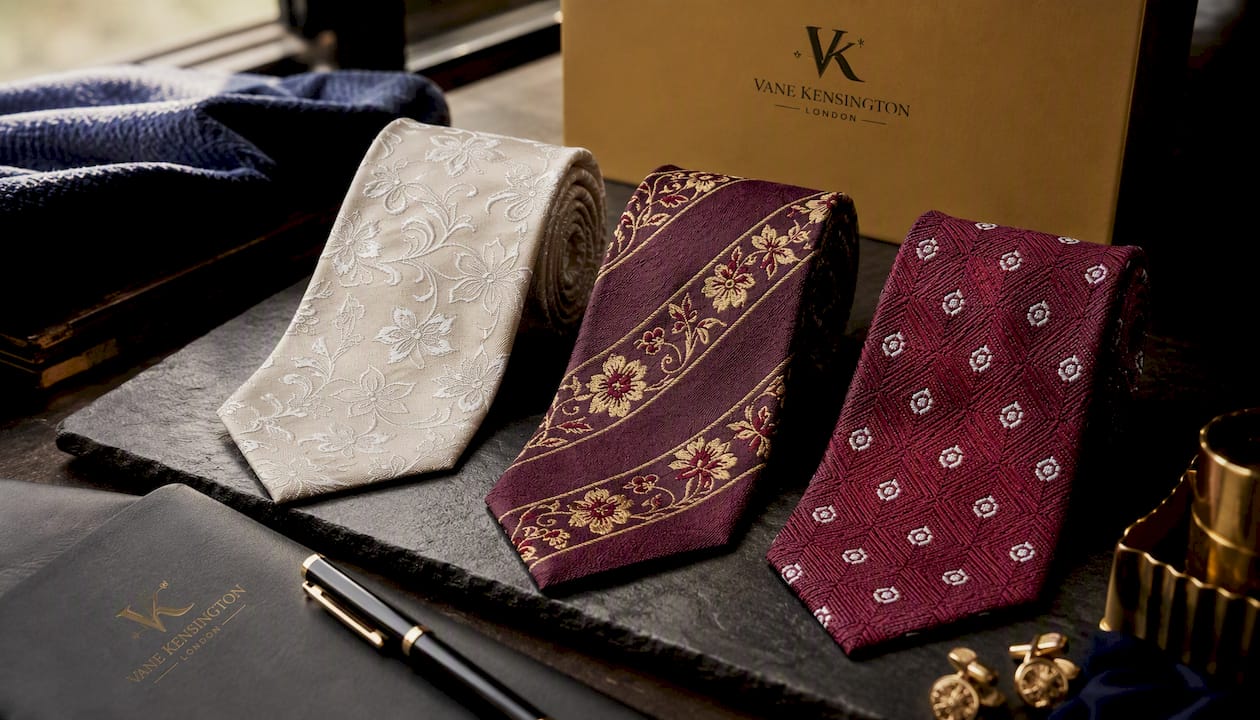
The Ivory Floral Tie works beautifully against a light blue shirt where you want lightness without losing formality. The ivory ground keeps the palette soft while the floral motif adds enough texture to avoid looking flat.
For darker settings, The Highgrove Burgundy Floral Tie brings the warmth a light blue shirt needs for client meetings, its hand-finished silk catching light in a way that flat-woven ties simply don't.
The Mayfair Burgundy Diamond Tie suits interview settings and formal client work, its diamond pattern giving just enough visual interest against a plain shirt without tipping into distraction.
- Ivory Floral Tie: light blue shirts, softer formal settings
- Highgrove Burgundy Floral Tie: light blue shirts, client meetings, added warmth
- Mayfair Burgundy Diamond Tie: interviews, formal client work, textured pattern
Try each against your own shirt in the virtual tie fitting room before you commit.
Looking after a tie so the colour and shape last
A silk tie holds its colour and shape for years if you treat it correctly, but the wrong habits will flatten a knot or dull a dye faster than most men expect.
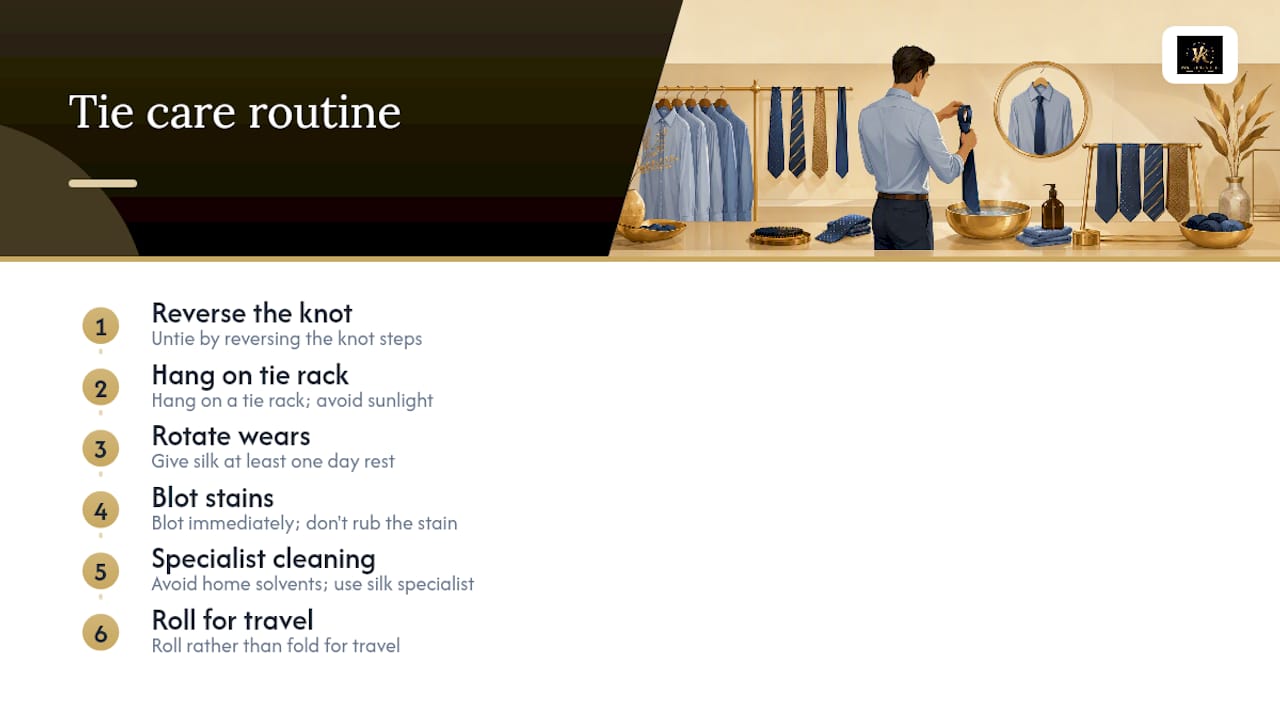
Always untie a tie by reversing the steps you used to tie it, rather than pulling it loose over your head. Yanking it stretches the fabric and can leave a permanent kink where the knot sat. Once removed, hang it on a proper tie rack rather than leaving it knotted or folded in a drawer, which allows the silk fibres to recover their shape between wears.
Rotate your ties rather than reaching for the same one daily. Giving silk at least a day of rest between outings lets the fibres relax fully, and it noticeably extends the life of the weave.
Stains need patience, not panic. Blot immediately with a clean, dry cloth rather than rubbing, which only drives the stain deeper into the silk. Avoid home dry cleaning solvents on delicate weaves like grenadine, and take genuinely stubborn marks to a specialist cleaner experienced with silk rather than a general dry cleaner.
Store ties away from direct sunlight, since UV exposure fades dye far faster than normal wear does. A wardrobe or drawer works better than an open hook near a window. Roll rather than fold a tie for travel, since folding creates sharp creases that are difficult to remove, while rolling protects the interlining and keeps the shape intact for the next wear.
Coordinating pocket squares and cufflinks with your blue shirt and tie
Accessories either finish an outfit or undo it, and the difference usually comes down to restraint rather than ambition.
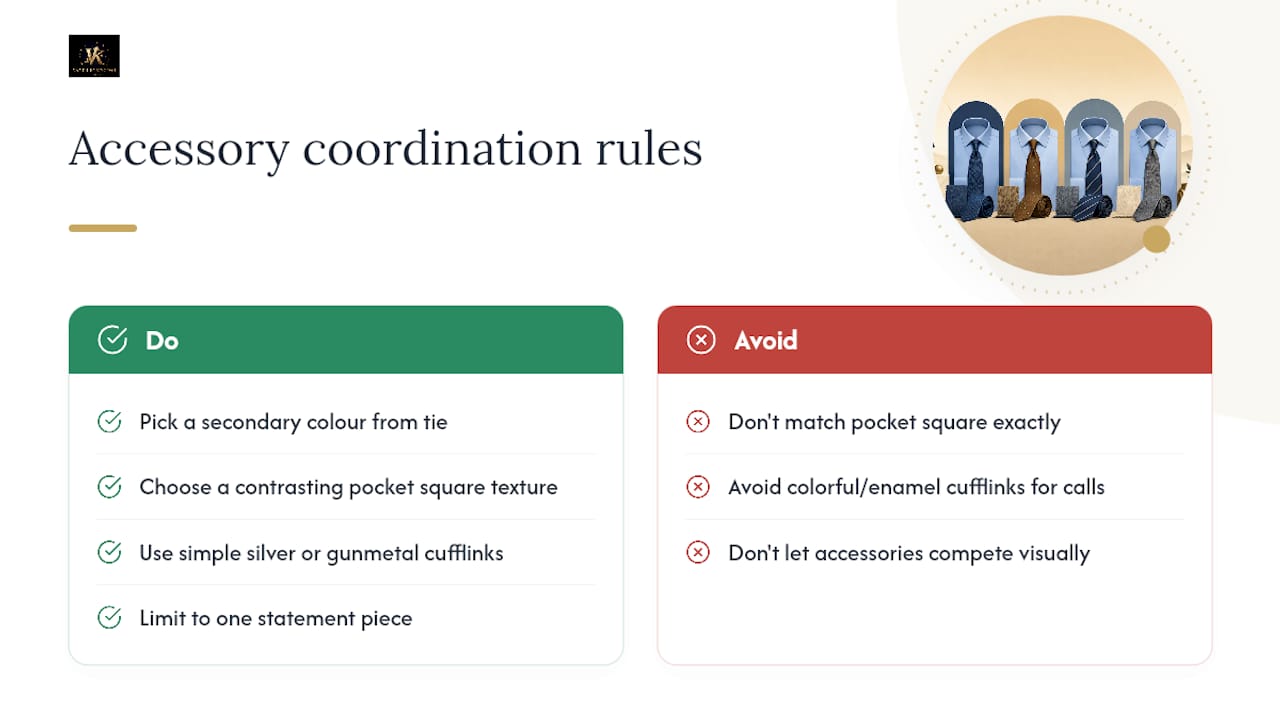
A pocket square should never match your tie exactly. That level of coordination looks like a matched set bought off a shelf rather than an outfit someone actually put together, and ready-made shirt and tie sets tend to look exactly like what they are for that reason. Instead, pick up a secondary colour from the tie's pattern, or choose a texture that contrasts gently with the tie's fabric. A burgundy tie with a small paisley pattern pairs well with a plain white or pale grey pocket square rather than a burgundy one.
Cufflinks carry less colour risk since they're small and usually metallic, but they still need to match the formality of the room. Simple silver or gunmetal cufflinks suit almost any blue shirt and tie combination. Save anything with colour, enamel, or a decorative motif for events where a bit of personality is genuinely welcome, such as a wedding rather than a Tuesday client call.
The general principle holds across all accessories: one statement piece per outfit is plenty. If the tie is doing the visual work, let the pocket square and cufflinks stay quiet.
What I'd keep and what I'd risk
The navy and burgundy rules for light blue shirts aren't outdated, they're just underused. Most men reach for safe over sharp when the two aren't actually in conflict. The real risk worth taking is texture: a grenadine weave or a floral motif on a dark shirt does more for you than another plain silk tie ever will. For deeper pairing rules, our guide to matching ties with suits is worth a read.
— Tajmilkha
Try the pairing before you buy the tie
Some ties are woven in limited runs from fine silk and finished entirely by hand, which is exactly why texture reads so differently on a blue shirt than it does with a mass-produced tie. The Ivory Floral, Highgrove Burgundy Floral, and Mayfair Burgundy Diamond ties each solve a different pairing problem covered above, from soft formal wear to interview-ready contrast.
Rather than guessing how a tie will look against your own shirt, test the combination directly in the virtual fitting room. It shows you the pairing before you commit, which matters more with hand-finished silk than with a basic off-the-rack option. Browse the full tie collection to compare options side by side, or, if you're building the whole outfit from scratch, look at our made-to-measure suits cut to your own dimensions rather than pulled from a rack. Pick a piece, try it against your shirt in the fitting room, and see how it looks before it arrives.
Sources
- How to match ties with shirts: full guide | The Tie Bar (blog)
- How to match a shirt with a tie | Eton
- What Colour Tie Goes with a Blue Shirt? | Berle
FAQ
What colour tie is best with a blue shirt?
Navy and burgundy are the two most reliable choices for a light blue shirt, giving you contrast without looking mismatched. For a dark blue shirt, go lighter with grey or add warmth with gold and bronze accents so the outfit doesn't flatten into one tone.
What does a blue tie signify?
Blue ties are generally read as trustworthy and calm, which is part of why navy dominates political and corporate wardrobes. On a blue shirt specifically, a tonal blue tie needs genuine texture or a lighter shade to avoid disappearing into the shirt.
What is the rule for tie color?
The most useful working rule is to echo one colour from the shirt in the tie rather than matching the whole pattern, and to keep the palette to two or three colours total. Vary the pattern scale too, pairing a fine shirt pattern with a bolder tie or a solid.
What colour goes with a blue shirt?
Beyond navy and burgundy, dark green, muted purple, and light grey all work well depending on how dark the shirt is. Vane Kensington's Highgrove Burgundy Floral Tie and Mayfair Burgundy Diamond Tie are built specifically around this kind of blue shirt pairing.